


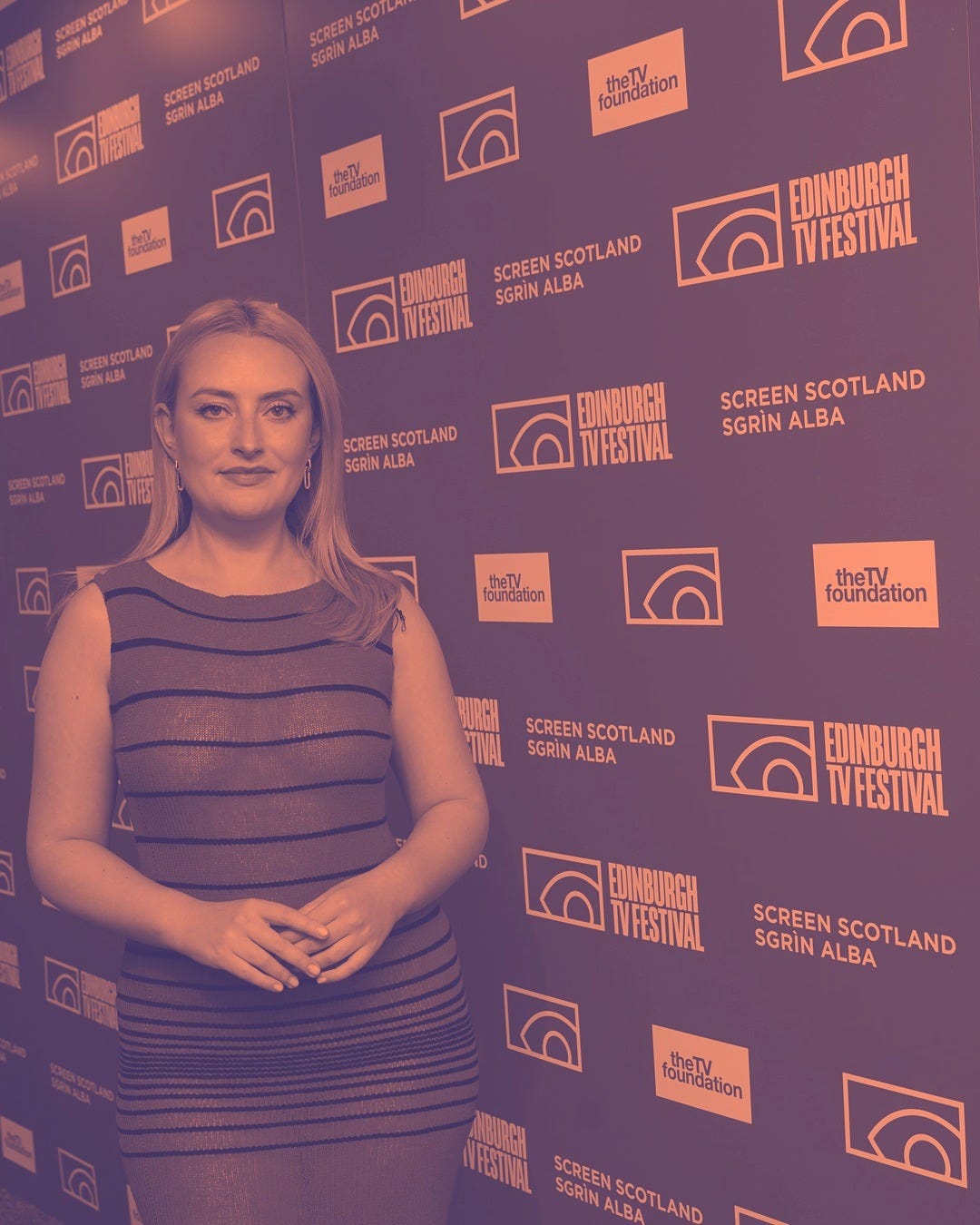
Amelia Dimoldenberg was often name-dropped by YouTube executives at last week’s Edinburgh TV Festival as an exemplary British talent who has assiduously built a brand on the platform. But the Chicken Shop Date mastermind is increasingly going against the grain of what’s expected of the creator economy.
“I have never wanted to be someone who is posting weekly,” she said in Edinburgh. “That’s maybe where I differ from other creators, because there are a lot of others who are posting different types of content to me who feel very much bound to releasing weekly or biweekly.”
But Dimoldenberg, who opened the festival on August 24 with an In Conversation event, has always valued quality over quantity, a strategy that she believes has added to the longevity of her YouTube series, which has been running for 12 years.
“If it was weekly, I don’t think it would be around for as long,” she said. “I would get bored of it. The audience would get bored of it. So, in a way, one of the greatest strengths of the show has been that I randomly post, and people hopefully are excited by that.”
While many in the TV industry are trying to break into YouTube, Dimoldenberg, who has interviewed everyone from Elmo and Andrew Garfield to Cher and Paul McCartney on her show, is doing the reverse: pushing for her big break in TV and film. She’s in development on a Skins-style drama for the BBC and is writing and starring in a romantic comedy based on her real experiences on Chicken Shop Date for Amazon MGM. The latter is produced by Will Ferrell’s indie, Gloria Sanchez Productions, which made the film Booksmart.
And yet even with these projects on the go, Dimoldenberg is adamant that she’ll always work for herself. “I hope to continue to self-fund projects long into the future because it’s important to me to be able to just go out and make something,” she said.
In a wide-ranging interview at Edinburgh, Dimoldenberg unpacked her business playbook and the strategies that have paid off for her as a digital creator.
Read on to discover:
Why Chicken Shop Date will never be sponsored
How to be selective with brands and make partnerships that are right for your vision
Why posting an unedited, 40-minute-long interview makes Dimoldenberg “feel ill”
What makes traditional film and TV deals so attractive to her at this point in time


Keeping the show ‘pure’ from brands
For many creators and production companies venturing online, brand partnerships are essential to keeping afloat financially. Yet that involvement can often dilute an editorial vision because brands often have requirements of their own to fulfil.
Dimoldenberg has done major commercial campaigns with the likes of Olay and M&S over the course of her career. It’s where she makes the majority of her money. “But I don’t do deals via Chicken Shop Date on the platform because I want to be in complete creative control,” she said.
“I don’t want to compromise my art,” she said, noting that she’s happy to “bend the creative” to work with a client and often does so on other projects.
“But with Chicken Shop Date, I just want that to be pure,” she said. “I want that to be just exactly what I want it to be, and I think that’s another reason why it’s lasted so long: because I’m not answering to anyone.”
Each episode costs roughly £4,000 and Dimoldenberg can generally make that money back on AdSense, YouTube’s partner programme for creators to earn ad revenue on the platform. The money that is earned is re-invested back into growing the brand.
“From the very moment I started making money with brands, I’ve always just thought, ‘Okay, I’m going to use that money, I’m going to put it back into my creative pot and I’m going to be able to self-fund,’” said Dimoldenberg.
However, there are always exceptions to her rule. One recent brand-funded series on her YouTube channel, for example, is Passenger Princess with F1, which the creator labelled as a “seamless” partnership. The series features Dimoldenberg getting into a car with various F1 drivers who are ostensibly teaching her how to drive. What appeals to her about that partnership, she said, is the access, because sports stars are notoriously difficult to book due to their schedules and reticence at unpaid appearances.
As a result, Passenger Princess is a symbiotic relationship: “I need the access, and I’m giving [F1] an entertainment format that is bridging the gap between their younger and older audiences, and having space on YouTube and collaborating with me as well,” she said.
You can collaborate with brands “really well across all social media platforms,” she assured, but you have to make sure you’re not sacrificing on the creative and that you align from the get-go on what your objectives are.
“My team and I are very particular when a deal comes over,” she said. “We go back and forth for a while, and things might be easier if you just say ‘yes’ to X amount of deliverables or whatever creative it is, without reworking it internally. But we do the opposite, so things can take a long time to get over the line sometimes.”
Takeaways: don’t work with brands if you want to maintain complete creative control; use brand-generated revenue to reinvest back into your passion project; some brand partnerships make sense if each party gets something substantial out of it

Kill your darlings
Chicken Shop Date episodes shoot for around 40 minutes, but are always edited down to under 10. Dimoldenberg said the edit is her favourite part of the entire process, “which is why I’ve always been very interested in narrative and storytelling in a broader sense.”
However, the idea of putting an unedited, full interview “out like a podcast makes me feel ill,” she continued. “That’s just not what I’m interested in at all. I’m interested in shaping and crafting something. So the edit is really important to me. And in terms of what I choose to edit out, I often edit out a lot of the sincere moments.”
Dimoldenberg joked that if anyone’s being serious or sincere, “or saying something that’s actually interesting, that’s going.”
“I’m very specific with what I think the show is, and if it doesn’t fit the brief of a Chicken Shop Date, and you can see it in another interview, then it’s not going to be included in my interview,” she said.
When asked about the metrics that are important to her, the creator surprised the audience by explaining how little time she spends looking at her analytics.
“I definitely look at views,” she said, “but I actually don’t ever go on the back end of YouTube. I spend way more time thinking about what guests we’re going to have on. That’s really important to me, the type of guests we can have on, the variety of guests and the level of guests, to me, is how I can often measure my success.”
Getting Jennifer Lawrence on the show while the actor was promoting her movie No Hard Feelings, for example, was a coup. “That was such a big measure of success,” said Dimoldenberg, because the Hollywood star did no other social video stops on her press tour.
“That’s something that I value. And then positive sentiment as well. I read a lot of the comments that I get on YouTube, and it’s amazing seeing what people say and interact with.”
Takeaways: editing is a major part of the process; Dimoldenberg doesn’t pore over Analytics but does look at view counts; success is measured by the level of celebrity she can attract
A Hollywood pivot
Despite her success on YouTube, where Dimoldenberg has 3.4 million subscribers, she said her ambition has always been to “make [her] own rom com.”
“I think, inadvertently, Chicken Shop Date has become my version of a rom com, simply because when I was 20, I couldn’t make a movie,” she said. “And I’ve always had dreams of writing a TV show, too. It’s not like it’s a new thing; it’s just something I’ve always wanted to do.”
It may appear to be counterintuitive, but Dimoldenberg’s drive to break into film and TV underlines how some creators with significant digital followings can also still desire greater access and budgets. “Television and film offer things I can’t get right now - the infrastructure,” she said.
“Young people are watching YouTube for sure, but they’re also still watching so much television,” said Dimoldenberg. “They’re watching drama. They’re watching teen series. And I would love always to get into that world and collaborate with really smart people who are amazing at what they do in scripted.”
Her parting advice for execs in the room was to “keep taking risks.”
“People have become very risk averse and they don’t want to do something if it doesn’t have a lot of IP or it wasn’t a book first or if it’s not a remake,” said Dimoldenberg. “But audiences are always craving original ideas, and so I say don’t be afraid of those things.”
Meanwhile, for young creatives wanting to break through, “I would say hold your integrity and have that self-belief that your idea is important and that, if you believe in it, then it will get made. It might just take a lot longer than you think.”
Takeaways: a Hollywood movie and TV deal provides infrastructure Dimoldenberg can’t get on YouTube; keep taking creative risks; don’t forgo your integrity to get things made
Hiring? We feature paid job listings, to book a listing, email hello@theindiehustle.com
Sponsorship? If your organisation would like to find out about sponsorship and advertising opportunities, email hello@theindiehustle.com
