


Premium history drama-documentaries are a competitive genre, particularly ones presented by celebrities.
Just putting a famous face or expert in spectacular locations is no longer enough for viewers who have become increasingly sophisticated.
But how do you find new ways to tell centuries-old stories that will appeal to streamers’ worldwide audiences?
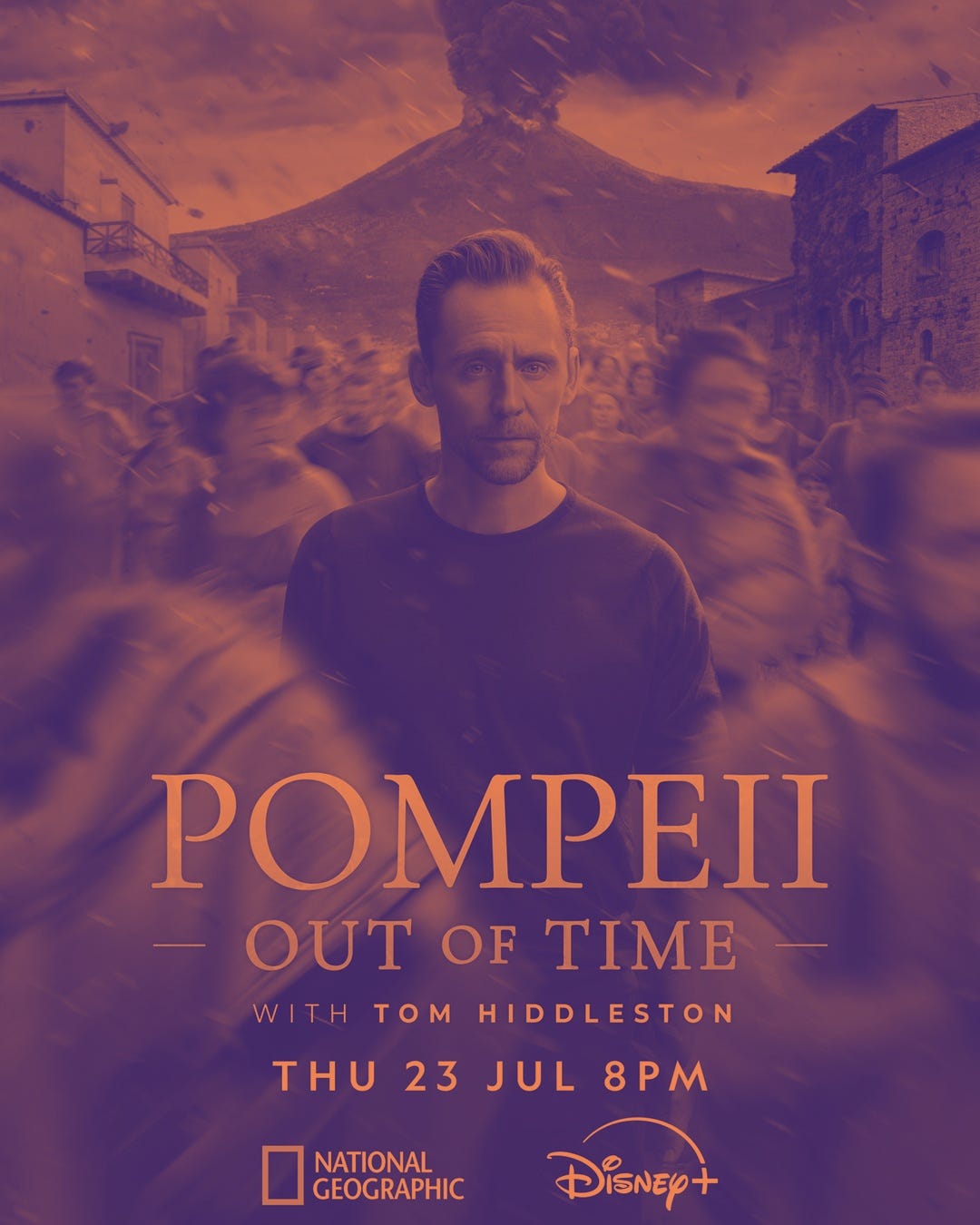
That was one of the challenges for the ambitious new National Geographic and Disney+ three-part series Pompeii: Out of Time, presented by Loki actor and amateur classicist Tom Hiddleston, who has been fascinated by what happened in the aftermath of the famous eruption of Mount Vesuvius in 79AD ever since he visited the site as a teenager.
By innovating and blurring the boundaries between drama and documentary, showrunner and director Tom Barbor-Might and producers Plimsoll Productions, which makes prestige shows such as Netflix’s Skyscraper Live, aimed to create a piece of event television that Barbor-Might describes as an “elevated docu-drama”.
“We realised we could tell the story of Pompeii from street level,” he explains. “We could actually follow real people. That felt genuinely new and highly personal.”
“It’s a “big swing” for Nat Geo”, says Plimsoll founder and chief executive Grant Mansfield (whose company’s biggest customers are streamers) and which he says offers useful lessons for others in unscripted.
Read on to discover insights about:
Reinventing the traditional drama-documentary
How expertise can matter more than celebrity
Building history shows that make an impact globally
Finance, distribution and AI in docu-dramas


Moving beyond the traditional drama-documentary
Drama-docs can sometimes sit awkwardly between the two genres, as Pompeii: Out of Time director Tom Barbor-Might explains, so he and the production team wanted to innovate.
“The drama often feels like it’s there simply to illustrate the documentary. What I really wanted was that when we did drama, we really did drama.”
That meant the actors’ scenes needed to stand on their own two feet, ensuring audiences could empathise with the characters.
Pompeii: Out of Time is described by Disney as “a fusion of cinematic scripted drama and investigative documentary storytelling that transports audiences to ancient Rome in the hours before and during the eruption of Mount Vesuvius.”
To create this new kind of show a top team was assembled including acclaimed theatre playwright Mark Ravenhill and Geek Girl writer Jessica Ruston. Additional writing also came from Loki executive producer and the series co-executive producer and former Marvel Studios executive (and ex-Marine Corps combat correspondent) Kevin R. Wright and Barbor-Might.
Plimsoll Productions founder and chief executive Grant Mansfield also contributed to the writers’ room in the early stages and explains. “We had proper collaboration between scripted and unscripted producers. I think what often happens with drama docs is that you get unscripted producers trying to make dramas on their own and that doesn’t tend to go so well.”
Rather than just reconstructing the events, the writers followed the lives of three Romans in the final hours before the eruption, based on stories that have emerged through years of excavation of the area around Mount Vesuvius and beyond.
The production’s starting point was the archaeological research. But Barbor-Might was also interested in interweaving the drama with Hiddleston’s conversations with experts such as geoscientists and historians.
He also wanted to include the actor’s own personal recollections of visiting the area when he was 17 and the effect it had on him.
Therefore the production deliberately blurred the boundaries between doc and drama by introducing (like BBC drama Small Prophets) elements of magic realism.
In Pompeii: Out of Time’s case this included time-travelling. It uses a similar plot device to the one used in Loki, with Hiddleston rewinding and forward-winding the action through time with a rotation of his hand as evidence emerges from the experts as to what happened to the real-life protagonists.
Action from the drama also sometimes has an effect in the documentary elements eg. the effect of shocks from Vesuvius’ eruption are shown in scenes involving Hiddleston in the present day.
Barbor-Might says he was keen to “make the division between the two timelines porous, but also the division between the two forms of filmmaking.”
However he adds that, “the responsibility is to be honest with the audience,” so any blurring between what is based on evidence and what on imagination (drawn from logical conclusions when there are gaps in the archaeological record) is signposted clearly so viewers know.
The result, according to Tom McDonald, EVP of content at National Geographic, has been a “process of inventing an entirely new genre of history programming - one which brings evidence and imagination together in a way which feels distinctive.”
Takeaways: treat drama as storytelling in its own right, not simply as illustration; innovation and magic realism can help you stand out in a crowded docu-drama market
Expertise and celebrity
Having a globally-recognised star front your show undoubtedly helps get a commission, particularly from a streamer.
Hiddleston knew Plimsoll from a previous show he had worked on with them and his enthusiasm was a catalyst for the programme; he was in the original pitch.
His expertise in the area - he has a double first in classics from Cambridge - also made a difference.
“It really did start with Tom,” explains Barbor-Might. “The classical world is a genuine passion of his. If you ever spend time with Tom he will start telling you about classical history. This is what he lives and breathes.”
Plus, Mansfield says, “He’d mentioned [to Plimsoll USA chief Alan Eyres] he was interested in unscripted TV… there’s a genuine interest there.”
Rather than acting just as a narrator delivering facts to camera, Hiddleston experiences the discoveries alongside the audience; even some things he gets wrong are left in.
An A-list name may help secure attention, but viewers are often more invested in a show when the presenter genuinely cares about the subject.
Barbor-Might explains: “We wanted Tom to be emotionally invested. He isn’t there simply to deliver information. He goes on the journey with the audience.”
Mansfield adds: “He doesn’t really play a character. He plays himself. He has real emotional intelligence and is capable of tapping into the emotion of these stories because the interest is authentic.”
The actor also became far more involved than many celebrity presenters, participating in writers’ discussions, working closely with production and keen to participate in the publicity campaign.
“He has been far more than a host,” points out Mansfield. “It’s been a real pleasure working with him and I know he wants to do other stuff in the unscripted space.”
Takeaways: genuine expertise rather than just celebrity appeal can elevate a show; build projects around people’s personal passions; involve talent creatively throughout development if you can
Making an impact globally
The streaming era has transformed the economics and ambition of high-end factual commissioning.
“If a streamer creates a hit now it becomes a hit all over the world,” observes Mansfield, as he found with Netflix production Skyscraper Live, where, “what surprised me was seeing it creating news in Taiwan, Russia and America at the same time.”
That global reach influenced the development of Pompeii: Out of Time from the outset.
Ancient Rome already carries worldwide recognition, while Hiddleston’s international profile and National Geographic’s global brand provided further advantage.
Built around the show are additional elements that will help boost its profile across territories.
As well as Disney giving the programme a big marketing push, Natgeo.com has a major story on three Roman cities buried by Mount Vesuvius in A.D. 79, which will feature in the August issue of National Geographic magazine (which McDonald oversees) and which it says is based on the latest AI and advanced DNA analysis of ancient Roman life - including “previously unreadable lost writings from Herculaneum’s [which is near Pompeii] carbonised scrolls and diet and disease from a Pompeii latrine.”
In addition a soundtrack featuring a score by composer Aisling Brouwer is being released through Hollywood Records to accompany the series.
Multiple points of entry for audiences, beyond the television series itself, are being created by Disney/Nat Geo that will feed back into the show.
Mansfield praises McDonald for backing an ambitious creative approach and seeing the impact it could have worldwide.
“It was a big swing,” he says. “He saw the potential from the beginning, kept his hand on the tiller all the way through [and] was incredibly supportive.”
Takeaways: create as many touchpoints as you can to draw viewers in from outside the screen; evaluate which historical events have particular global appeal
Finance, distribution and AI
The producers were lucky to have a good budget, which was fully-financed by Disney/Nat Geo.
Notably, the team decided early on that every visual effect would be created by human artists, not generative AI.
“There was no AI,” Barbor-Might says. “Everything was created by visual-effects artists.”
Mansfield goes on: “We took an early decision that we didn’t want to use AI. We were fortunate to have the budget to achieve what we wanted properly.”
But the production kept an eye on budget and saved money by using the Gladiator 2 set in Malta for some of the drama scenes.
Mansfield explains: “We were able to save money because we just jumped into that set so thanks to Ridley Scott!”
With more high-quality content competing than ever before, even excellent programmes risk disappearing without the budget for good marketing support.
Mansfield says the show is lucky to have “fantastic distribution platform in Disney+” but also advises that distribution alone is no longer enough.
“The challenge isn’t just making good television,” he says. “The challenge is making sure people find it.”
Takeaways: budget can dictate ethical decisions around AI; use existing sets to save money; even good shows can get lost if you just rely on distribution
Hiring? We feature paid job listings, to book a listing, email hello@theindiehustle.com
Sponsorship? If your organisation would like to find out about sponsorship and advertising opportunities, email hello@theindiehustle.com