


It may feel like half your LinkedIn contacts are building ‘portfolio careers,’ but TV makers may be surprised to learn that they should be taking the same approach to production.
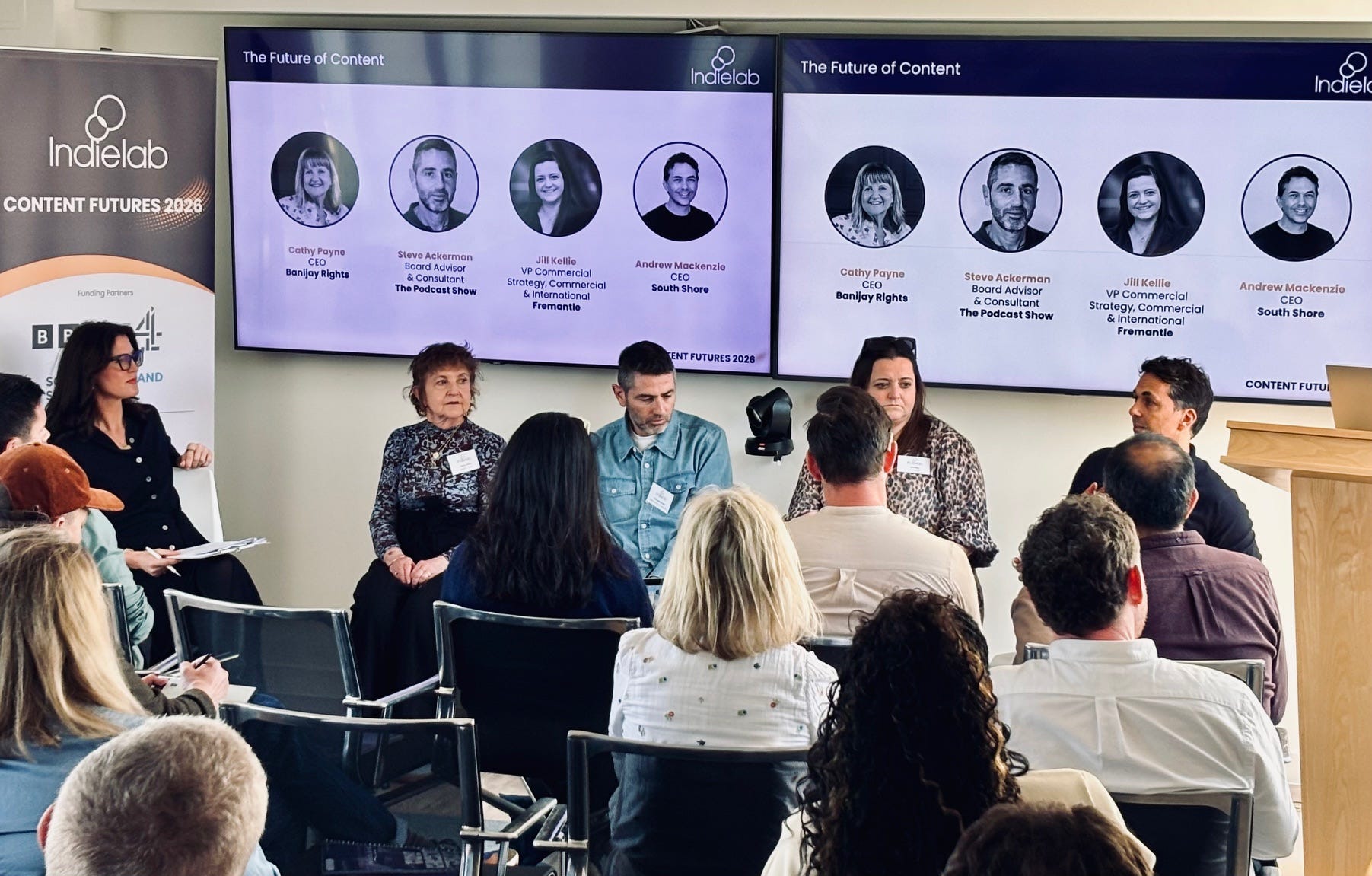
Indielab’s Content Futures programme last week saw top executives from Banijay Rights, Fremantle, South Shore Productions and the podcast world detail the revenue streams savvy producers need to be considering if they are to succeed in today’s market.
How will you go beyond your original commission? Where can your content live? What is your multi-platform strategy? These questions need to be top of mind in development, financing, production and distribution.
Today, The Indie Hustle breaks down key learnings about the future of content, including how indies can best work with brands, squeeze the most revenue out of digital and explore the world of opportunity in audio.
Read on to find out:
Why independent data-gathering is key to a successful brand partnership
The in-demand genres still landing sales for international distributors
Why any indie can recalibrate as a podcast prodco
Why a two-year digital strategy for back catalog shows is essential

Breaking into branded? Fund your own data research
In the span of five years, South Shore Productions has become one of the UK’s most prolific indies working in brand-funded entertainment, with credits including Champions: Full Gallop, The Great Escapers and M&S: Dress the Nation. These shows now comprise one third of the company’s revenue.
As The Indie Hustle recently reported, there’s no set model of how to work with brands, but South Shore co-founder Andrew MacKenzie said his team often has the same conversations with brands as they do with TV commissioners, particularly as select brands have marketing budgets that are equal to the commissioning budgets of some channels.
“You’re trying to persuade them that television can be part of their story and can give them a significant return on investment by dealing directly with what their story is,” said MacKenzie. “So, it’s a really similar relationship to the one [you have with] a commissioner.”
Brands are, in fact, “much more commercial” than some commercial broadcasters in that they are data-hungry and keen to see immediate returns on investment. To meet this need, South Shore works with an independent agency to collate data on how their branded commissions have landed. “We want it to be independent,” said MacKenzie. “We want it to be verifiable and not something we’ve made up.”
Having that data means the indie can then tell British Racing, their partner on ITV1’s Champions, that 70% of the audience is more likely to go to a horse racing event having seen their show. Or Aldi that their Channel 4 show Aldi: The Next Big Seller means people are more likely to set foot in an Aldi store.
Takeaways: data is imperative for brands, which need to see speedy ROI; fund your own data collection to present independent findings

Think beyond the commission
Fremantle VP of commercial strategy Jill Kellie’s resounding advice for indies was to think beyond their original commission and keep their eyes firmly on digital and what success in that realm looks like.
“Sometimes you just want reach and eyeballs, or you just want to look at how to exploit your back catalogue,” said Kellie. But mastering digital isn’t only about posting episodes and expecting revenue.
“It’s not just a ‘dump and run’,” continued Kellie. “You’ve got to work at it over months. You’ve got to build up a two-year content strategy about how you’re hosting that content with regards to format, the duration of that content, understand what’s working [and what] is really driving watch time from a revenue perspective.”
If a piece of content isn’t performing well online, Kellie advised revisiting thumbnail imagery, repackaging and reposting, or even crafting a compilation.
“It’s really about understanding the content you have and how that can work and also who you can work with, because all of the big studios are really keen to work with third parties in this space,” said Kellie.
The exec noted that Fremantle, whose content racked up 35 billion views on YouTube and Facebook in 2025 alone, has done “a whole host of deals” in the last 12 months with UK indies across a range of content.
Similarly, Banijay Rights boss and distribution veteran Cathy Payne noted that the company is hyper-focused on what happens to content beyond its “premier run.”
“Behind the [subscription] wall on Amazon is all revenue share and that does huge business for us,” said Payne.
The exec added that Roku has been surprisingly lucrative. “I thought there was a mistake when our figures came through from January for Roku and in [one] month, it was nearly as much as the whole of 2024 on a title I would have never believed.”
Takeaways: plan a two-year strategy for your content on digital; Fremantle is working with UK indies on digital deals for back catalog content; premier run no longer be-all end-all for distributors; Roku increasingly lucrative
You’re a podcast prodco. You just don’t know it yet
TV producers wondering how to expand into audio may not realise it, but they have a number of relevant and transferable skills, according to Steve Ackerman, the former head of global podcasts for Sony Music Entertainment.
“You know how to tell stories or create formats; you may be a specialist in a subject area; you may have really good links with celebrity talent or well-known hosts,” said Ackerman. “You obviously know how to shoot, light and edit and it’s a lot easier to learn audio editing skills if you have video editing skills, than to go the other way around.”
The value of podcasting has changed tremendously in recent years. Ten years ago, a podcast was seen as a proof of concept that could help you sell a show into a global streamer. But in the last 12 to 18 months, “it’s swung to the other side,” said Ackerman, noting that Netflix is now aggressively buying video podcasts. (Stay tuned for a deep-dive Indie Hustle interview with Steve Ackerman in the coming weeks.)
Takeaways: producers can organically transfer video productions and editing skills to audio; strong visualised podcasts are in demand
In demand: factual, scalable formats and lower-cost drama
What was Banijay Rights’ top-selling show out of February’s London TV Screenings? It wasn’t a pricey period drama, but rather the BBC’s Clickbait Clinic fronted by Stacey Dooley. Banijay Rights’ Payne said the Nutopia-produced series, which interrogates the wildest health trends on social media, was the company’s “most popular show.”
“Stacey isn’t really well known [internationally], but it was touching on a subject that is global,” said Payne. The title’s success suggests there is now “big demand for factual content,” added the exec, who urged producers not to underestimate what a global “calling card” valuable British IP can be.
Payne also underlined the importance of crafting scalable formats that can be made on either a huge budget or funded by multiple partners. Meanwhile, on the scripted side, she said buyers are looking for commercial shows with reasonable budgets. Reflecting on recent investments, Payne said four third-party scripted projects have been made with “good talent” for between £1.6 million to £2.2 million.
“They’ve been able to get other partners involved and look at clever tax breaks,” said Payne.
The exec said the market is still seeing a lot of “enhanced presales,” which means a territory will come in early, have some degree of editorial input (without driving the project) and be able to call a title an original. However, Payne advised that if producers want to land enhanced pre-sales on their projects, “You need to ask why that [country] needs to buy this before it comes to market. It has to be something that has just as much story interest in that market as it does here.”
Takeaways: demand returning for British factual content; scalability of a format is more important than ever; appetite among buyers for lower cost drama; enhanced presales still popular but need to have a reason for them
