


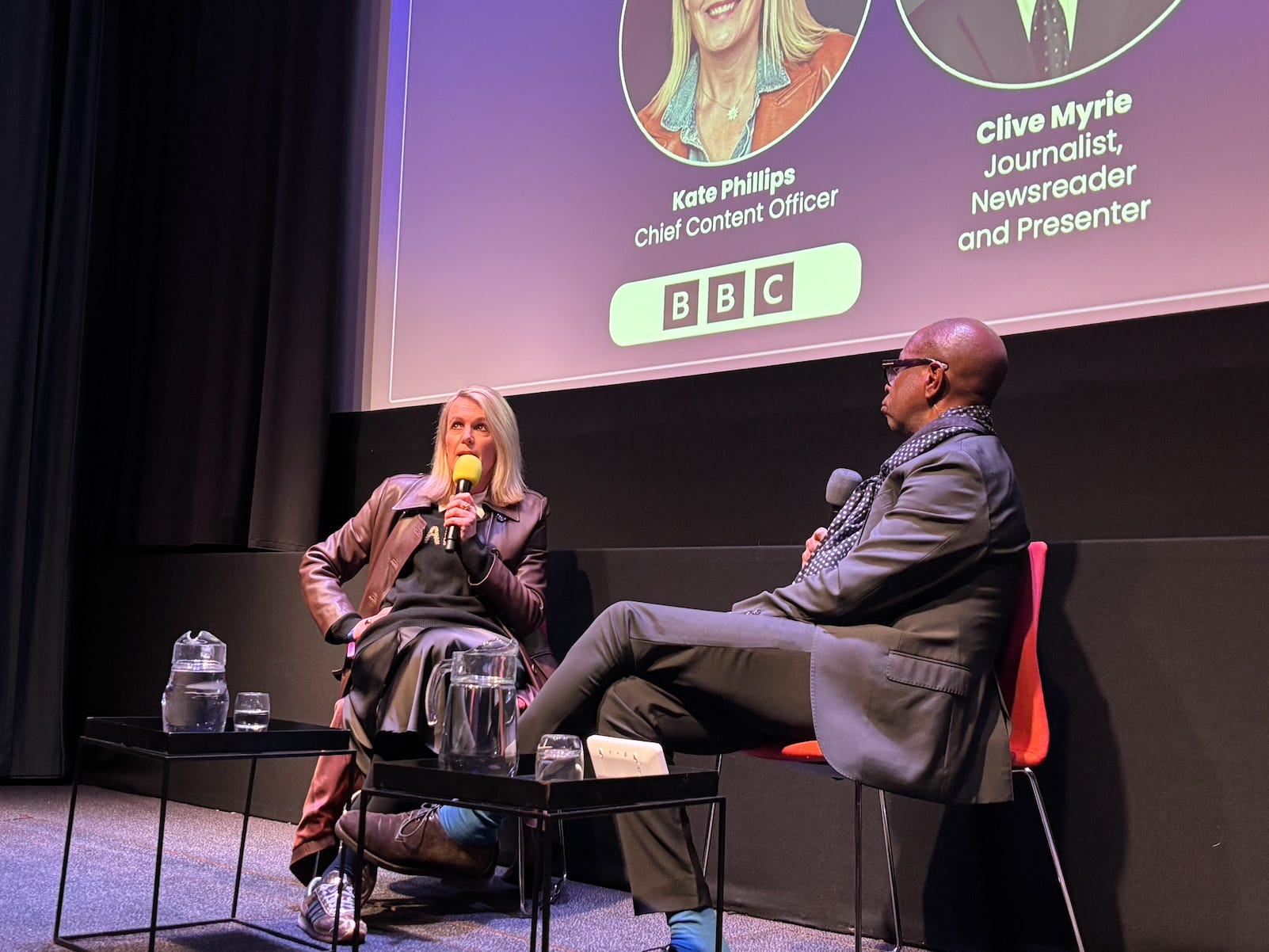
BBC Chief Content Officer Kate Phillips has said the UK industry is experiencing a #MeToo moment following Russell Brand’s rape conviction and the David Walliams grooming allegations, and urged staffers at the corporation to “come to me direct if there’s anything, because I will act.”
“I’m not going to brush anything under the carpet,” said Phillips, who was interviewed by BBC broadcaster Clive Myrie at Indielab’s GrowthLab event in London on Tuesday (Nov. 17). The anchor asked about the impact of the Brand and Walliams revelations — which the latter actor denies — and what the BBC is doing to make the workplace safer.
“You need to obviously gather the information and make sure it’s factually correct. But as soon as I’ve got that, they’re out of here because no one is irreplaceable and no one is above this,” said Phillips.
The executive revealed she has “shocking stories” about how she was treated as a young researcher coming up in the UK TV industry in the 1990s, though she felt powerless at the time to complain.
The BBC launched a “Call It Out” campaign in late 2025 as part of a wider culture review that Phillips described as “very effective.” The corporation, she said, is stamping out bad behaviour faster since she and Charlotte Moore have occupied the Chief Content Office role at the BBC.
“You can only do the best job you can with the information you’ve got available,” she said. “But when the information’s there, those people are gone straight away. They are gone.”
The exec added that she wants to get to a place where a “Call It Out” campaign is unnecessary because harassment and wrongdoing in the workplace doesn’t happen, “because it is boring and it is exhausting, and it makes me angry when I still see the behaviour,” said Phillips.
“It’s boring that men still act like what was acceptable in the ’90s. We’re not in the ’90s anymore, and just because it was acceptable back then doesn’t make it right.”
Terms of Trade talks won’t be “bomb” under indies
Elsewhere, Phillips addressed BBC Director General Matt Brittin’s plans to revisit the Terms of Trade, assuring that the “underlying principles” will remain. “That principle that the indie owns their IP, of shows commissioned on the BBC, will stay,” she said.
The corporation is having active conversations with Pact, and looking at how the BBC can get more value from these shows, “but I want to reassure people: I don’t think we’re going to put a bomb under this any time soon, because it’s the lifeblood for the indies what they do with their IP and how they can then exploit that globally.”
Phillips, who used to sell global formats, said she is well aware of the importance of owning your own IP. “And I think it’s why people bring us their ideas…because they can own their IP,” she said. “Whereas if they go to the streamer, they’ll get a big budget, but they’re giving that away. For me, it’s really important that indies do retain that.”
The exec also spoke extensively about the BBC’s recent budget cuts. Broaching the topic, Myrie quipped that Brittin was “wielding an axe like a drunken sailor” on the corporation: “I’ve been at the BBC for 40 years and I’ve never seen anything like this,” he said. In a bid to save £500 million over the next two years, the BBC has so far announced it is cutting around 10% of its workforce, and BBC Three and BBC Scotland will soon become digital-only offerings.
Phillips noted that she must save £100 million in 2027/2028, meaning the corporation will lose 100-150 hours out of 3,500 hours, but will remain the biggest commissioner of indies in the UK. (The BBC commissioned 310 indies in 2025 and 60% of its spend went to companies outside London, she said.)
“We’re still punching and very much open for business and open for commissioning,” said Phillips, “but we will be looking at where we commission, what other platforms we go on to, and also looking at more partnerships.”
She noted that the BBC “managed to do The Traitors because we did it as a partnership with NBCU.” Phillips would like to employ that hub model on more shows, she said, but promised it will not “rein in our ambition.”
The BBC still has a “healthy” development budget, she continued, but has to be “cleverer” in how the money is spent. Winterwatch may have been canceled, but in its place will be the year-round visualised podcast Naturewatch.
“With these savings, I want to reduce the impact on all of you, on the indies,” said Phillips. “I still want to be commissioning from a lot of indies of all sizes, and I want to reduce the impact on the audience because, ultimately, content is king. We are the engine room of the BBC, and if we don’t have good content, people are not going to pay their licence fee, whatever format it’s in in the future. So, we’ve got to keep content strong, and I will keep banging that drama every level of the BBC.”